What Wood Is Better for Kitchen Cabinets: 5 Pro Picks for Paint or Stain
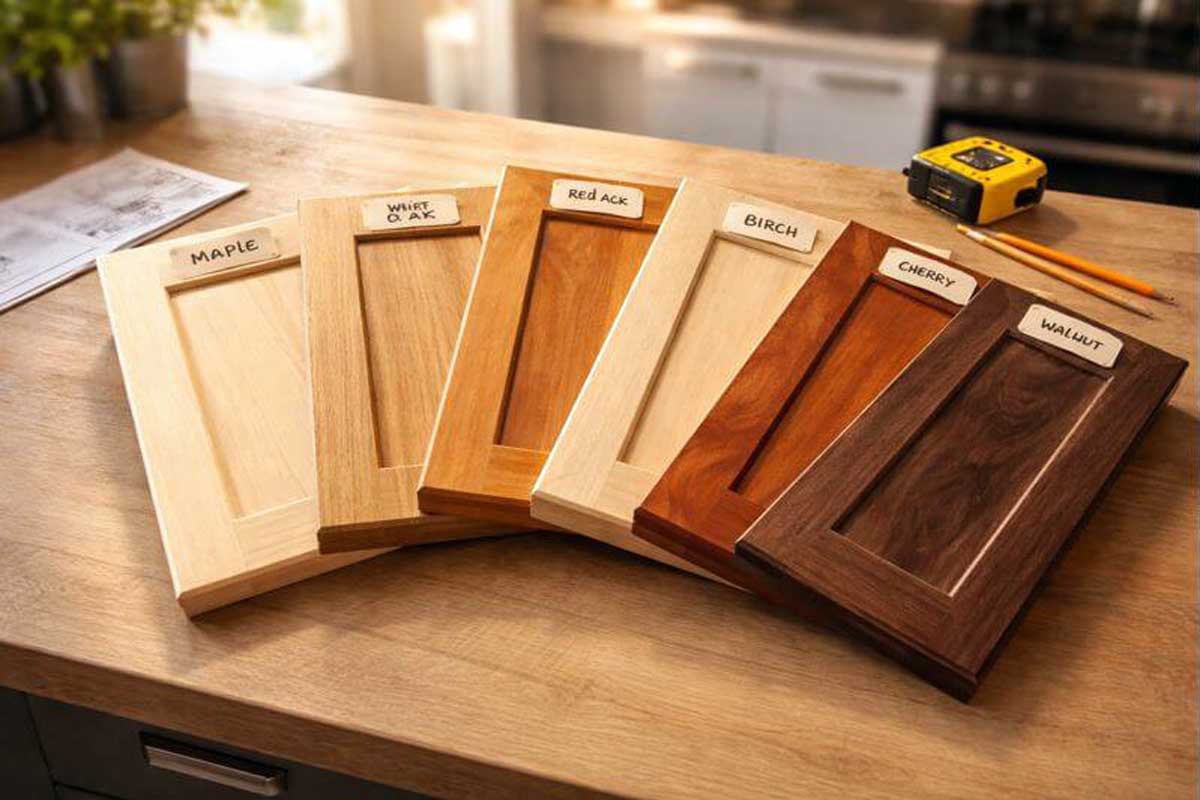
To choose what wood is better for kitchen cabinets, match the species to your finish goal (paint vs. stain), your abuse level (kids, pets, rentals), and how much natural grain you want to see. Hard maple and white oak make the most dependable “workhorse” cabinet woods, while birch, cherry, walnut, hickory, and paint-grade options each win in the right lane.
Quick picks (shop-floor practical):
- Best all-around for most kitchens: Hard maple doors/frames + cabinet-grade plywood boxes
- Best modern natural look: White oak
- Best painted cabinets: Maple face frames/doors + MDF center panels (or a tight-grain hardwood)
- Best value hardwood look: Birch
- Best “tough rustic” personality: Hickory
- Best high-end warmth: Cherry
- Best high-end contrast/modern luxury: Walnut
Contents Here
- 1 Which factors actually make one cabinet wood better than another?
- 2 Is hardwood always better than softwood for kitchen cabinets?
- 3 Should cabinet boxes be solid wood or plywood?
- 4 Which wood is better for stained kitchen cabinets?
- 4.1 Why does hard maple work as an all-around cabinet wood?
- 4.2 Why do white oak cabinets stay popular for natural finishes?
- 4.3 When does red oak make more sense than white oak?
- 4.4 Why do cherry cabinets feel warm (and why do they change)?
- 4.5 Why do walnut cabinets look high-end without heavy stain?
- 4.6 When is hickory the better choice?
- 5 Which wood is better for painted kitchen cabinets?
- 6 What wood is better if you have kids, pets, or a high-traffic kitchen?
- 7 How do popular cabinet woods compare side by side?
- 8 What construction details matter more than the wood species?
- 9 How do you choose the best wood for your kitchen in 10 minutes?
- 10 Common Questions About Kitchen Cabinets Wood
- 11 Final thoughts on Kitchen Cabinets Wood
Which factors actually make one cabinet wood better than another?
A cabinet wood is “better” when it stays flat, takes a finish predictably, and shrugs off dents in day-to-day use.
- Moisture behavior: Wood pulls moisture from the air and gives it back, so kitchens stress cabinets with humidity swings and wipe-downs. The U.S. Forest Service notes wood is hygroscopic, and moisture exchange depends on air temperature and relative humidity.
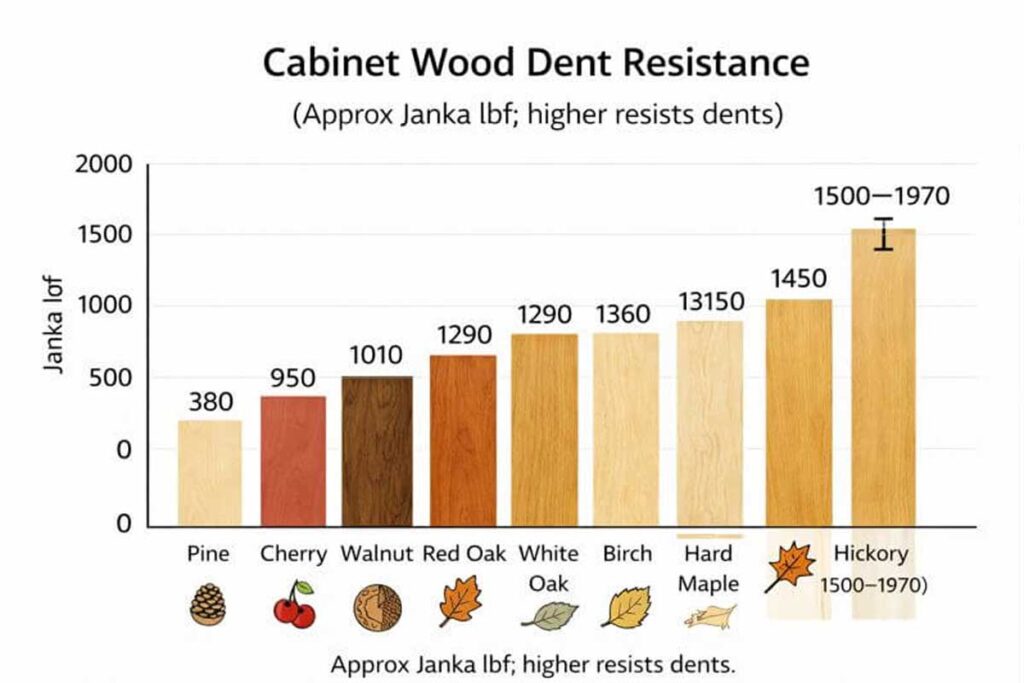
- Dent resistance (hardness): Harder species usually resist dings at the sink base and trash pullout. The Janka hardness test measures the force needed to press a steel ball into wood; higher numbers generally mean better dent resistance.
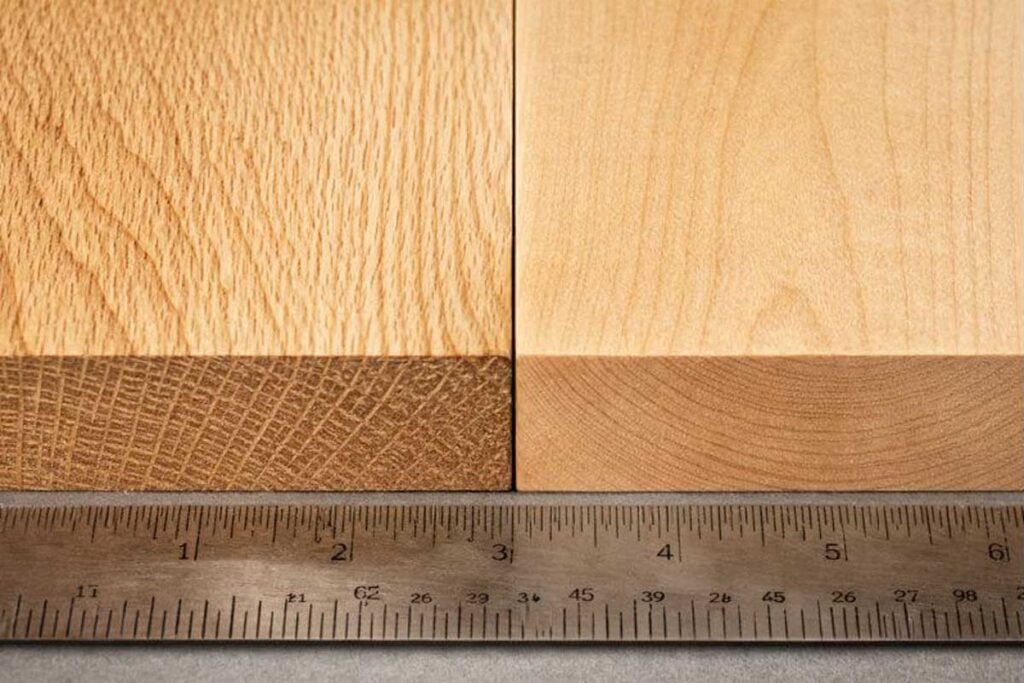
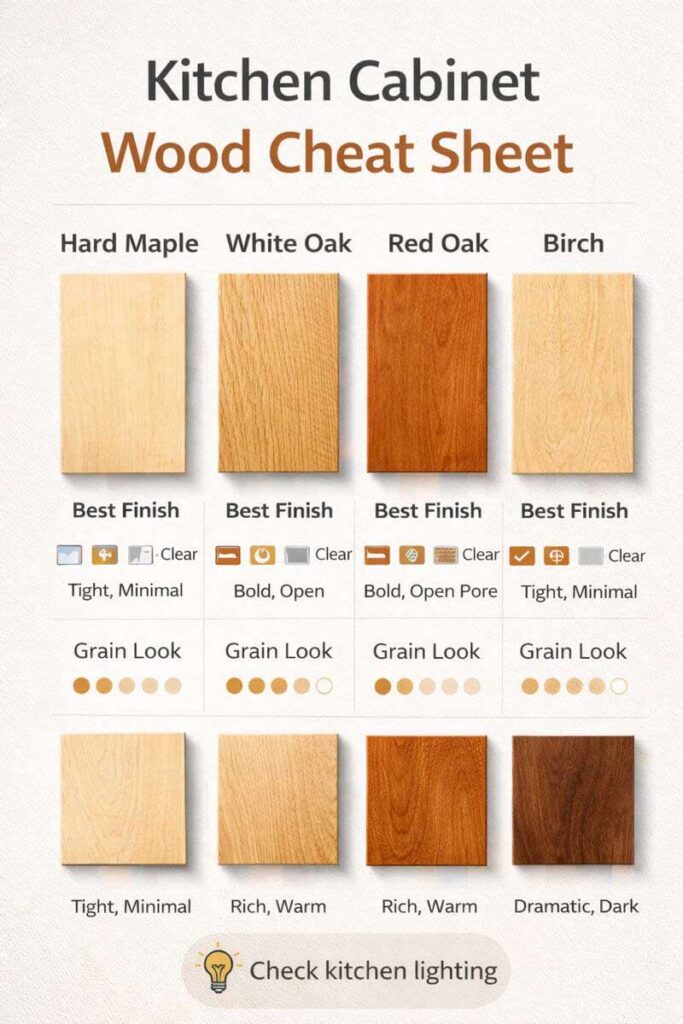
- Grain + pore structure: Open-pore woods (like oak) show grain boldly and can take stain evenly, but they may need grain filling for glass-smooth paint. Tight-grain woods (like maple) paint beautifully but can stain blotchy without a good prep schedule.
- Stability by construction: Cabinet doors are frame-and-panel for a reason—panels float so seasonal movement doesn’t split joints. Boxes often perform best when they’re engineered sheet goods, not solid boards.
Also learn: What exactly Shop Grade Plywood is
Is hardwood always better than softwood for kitchen cabinets?
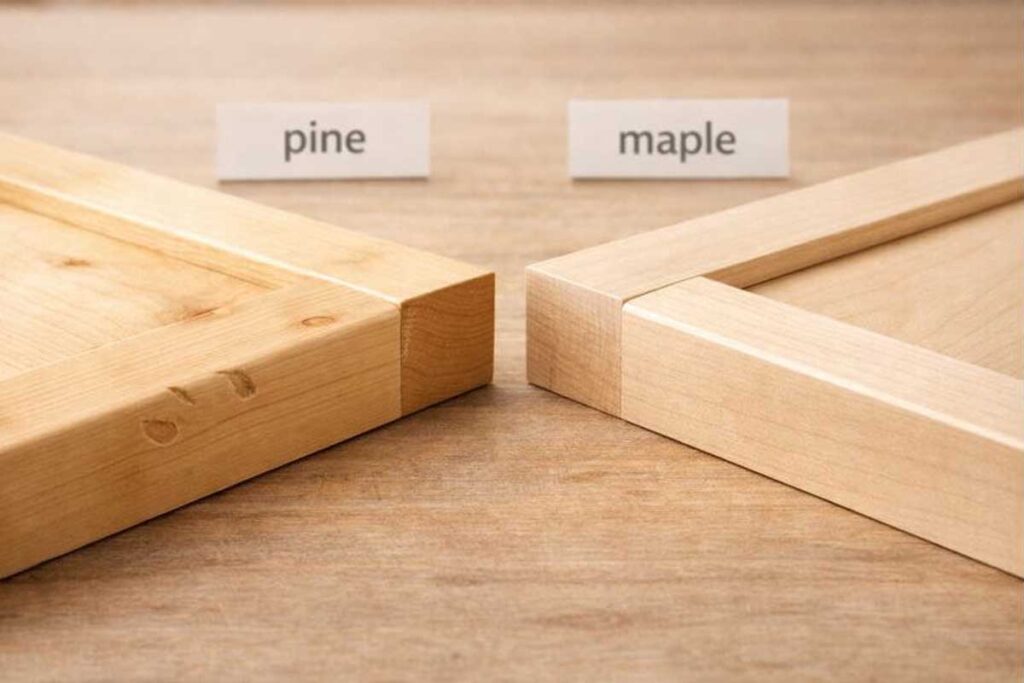
Hardwood is usually better for busy kitchens because it resists dents and wear more than typical softwoods, but softwood can still work if you accept “character marks.”
- Hardwood win: Maple, oak, birch, and hickory take knocks better than most pine and fir.
- Softwood reality: Pine dents easier, but it also costs less and fits cottage/rustic kitchens where dings look intentional.
If you’re planning paint, softwood can be a reasonable choice for face frames and doors if the build is solid and you’re okay with a few dents over time.
If you’re weighing common species, my rundown on comparing pine vs oak vs maple for project fit can help you sort the pros/cons fast: pine-oak-maple comparison guide.
Should cabinet boxes be solid wood or plywood?
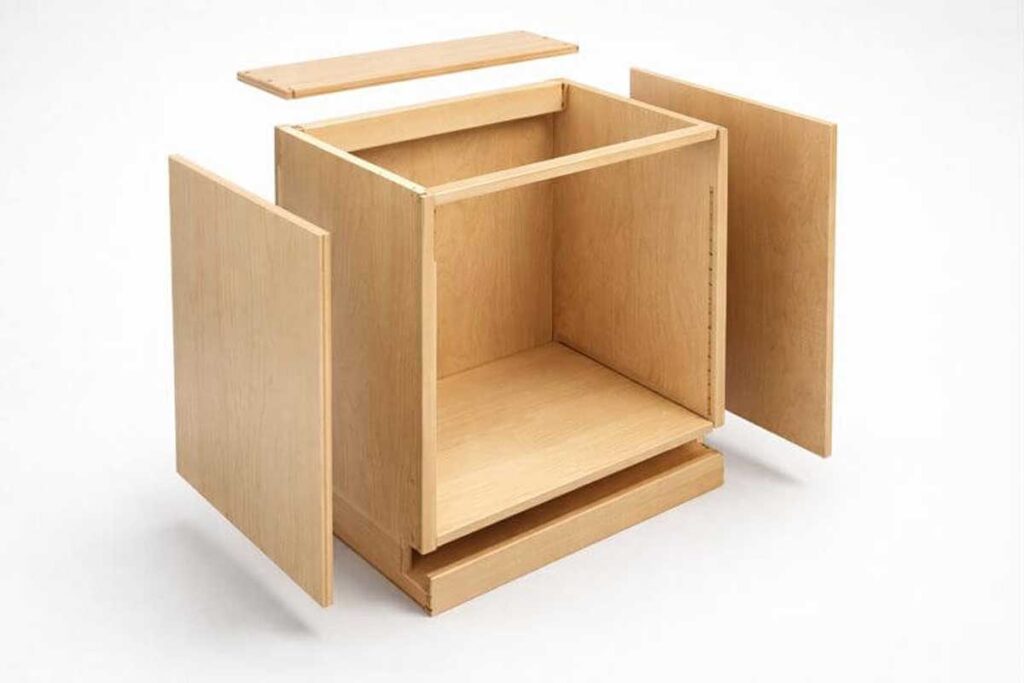
Cabinet boxes perform best when they use stable sheet goods (usually plywood) instead of solid wood panels.
Solid wood moves across the grain with humidity changes, so a wide solid-wood cabinet side can cup or split if it’s built like a tabletop. Veneered and engineered panels reduce that risk; Better Homes & Gardens notes veneered cabinets are more stable than solid lumber in high-humidity areas.
What I look for in a long-lasting box:
- 3/4″ cabinet-grade plywood for sides, bottoms, and fixed shelves (where budget allows)
- Proper backs (thicker or well-supported), especially for wall cabinets
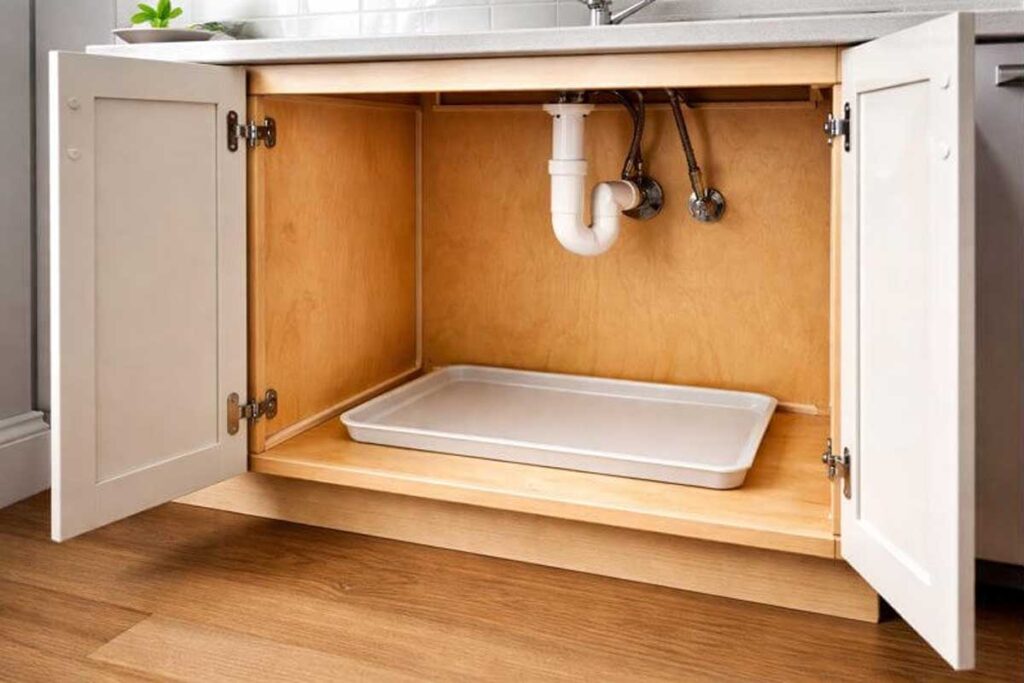
- Clean edge banding and sealed interiors (the sink base takes the worst hits)
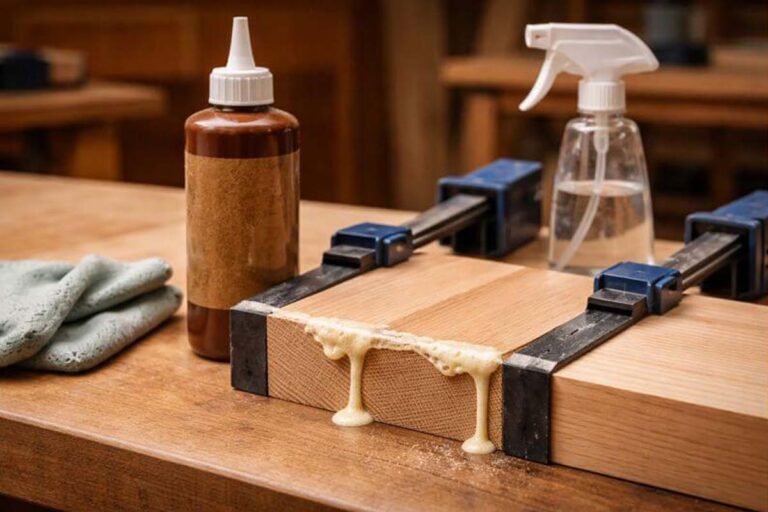
If you’re building or repairing boxes, adhesive choice matters on sheet goods—here’s my guide on picking a wood glue that plays nice with plywood layers: wood glue selection for plywood cabinet parts.
Which wood is better for stained kitchen cabinets?
Stained cabinets look best when the wood has attractive grain and predictable color shift under finish.
Why does hard maple work as an all-around cabinet wood?
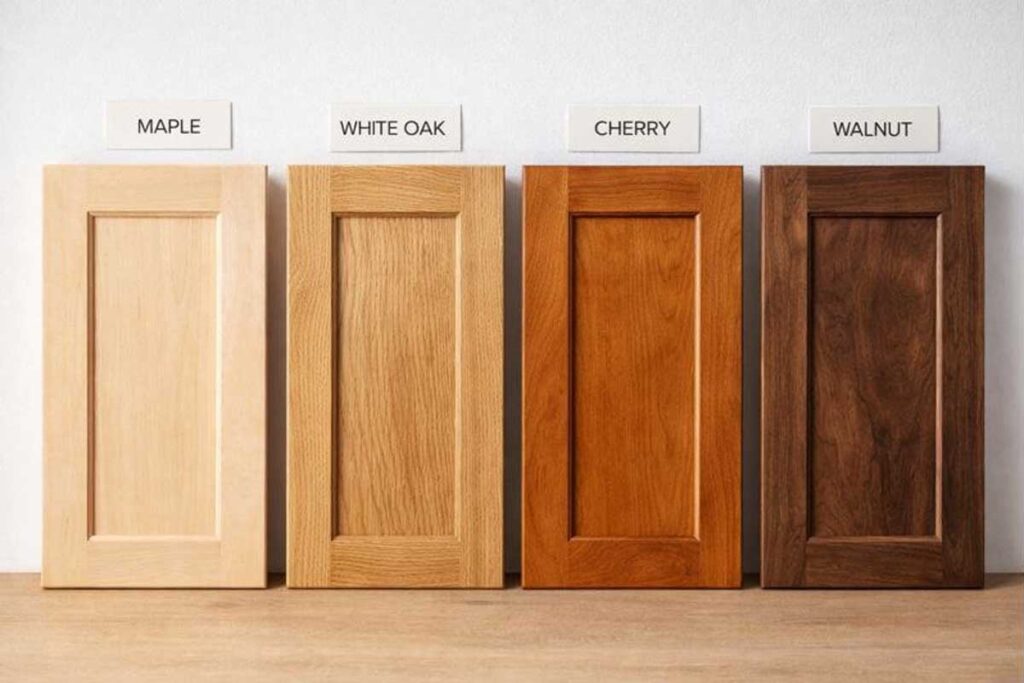
Hard maple works because it combines a tight grain with strong dent resistance, so doors stay crisp and edges hold up. Hard maple (sugar maple) posts about 1,450 lbf on the Janka scale, which is solid “family kitchen” territory.
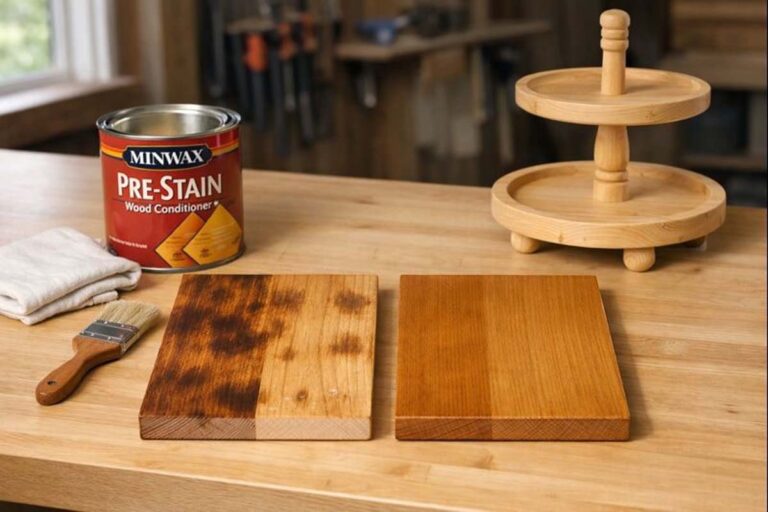
Practical note: Maple can stain blotchy—especially with dark stains—so your finisher’s schedule matters (dye, washcoat, or conditioner, then toner if needed). Today’s Homeowner specifically warns dark stains on maple can come out blotchy.
Best for: Clean, light-to-medium stains; modern or transitional doors; painted work too.
Why do white oak cabinets stay popular for natural finishes?
White oak looks good because its grain reads clean and intentional, and it handles daily wear well. White oak shows about 1,360 lbf on the Janka scale.
Shop tip: If you like a smooth “contemporary oak” look, you can keep the grain crisp with a matte clear coat and skip heavy stain.
Best for: Natural/neutral kitchens, modern or Scandinavian vibes, flat panels, light stains.
When does red oak make more sense than white oak?
Red oak makes sense when you want that classic bold grain and you’re watching cost. Northern red oak shows about 1,290 lbf on Janka.
Best for: Traditional doors, pronounced grain, budget-conscious stained cabinets.
Why do cherry cabinets feel warm (and why do they change)?
Cherry feels warm because it starts lighter and darkens with age and light exposure, building a deeper tone over time. Today’s Homeowner notes cherry can be more susceptible to dents than harder species like maple and oak, and it darkens as it ages.
Cherry’s Janka value is around 950 lbf, so it’s not fragile—it’s just not the toughest kid on the block.
Best for: Traditional kitchens, warm tones, homeowners who like natural patina.
Why do walnut cabinets look high-end without heavy stain?
Walnut looks rich because it starts dark and usually needs less color work—often just a clear finish to pop the grain. Black walnut sits around 1,010 lbf on Janka.
If you’re leaning walnut, my step-by-step on getting a clean, even clear coat on walnut helps prevent muddy grain: walnut finishing walkthrough.
Best for: Modern luxury, strong contrast, islands, statement runs of cabinetry.
When is hickory the better choice?
Hickory is better when you want a cabinet that can take abuse and still look “right” with a few scars. In the Janka list, common hickories run roughly 1,500–1,970 lbf depending on the type (bitternut around 1,500; mockernut around 1,970).
Best for: Farmhouse/rustic styles, high-traffic kitchens, heavy-use homes.
Know more: What is exactly Cabinet Grade Plywood
Which wood is better for painted kitchen cabinets?
Painted cabinets look best on woods that have tight grain and minimal pore texture, or on smooth engineered panels.
Why does maple make a strong painted cabinet?
Maple makes a strong painted cabinet because it has a tight grain that doesn’t telegraph through paint as aggressively as open-pore woods. It also holds edges well, which matters on shaker doors.
Watch-out: Maple can still show subtle grain “print” if the paint system is thin or rushed. A proper primer and sanding schedule fixes most of that.
When does MDF belong in painted cabinet doors?
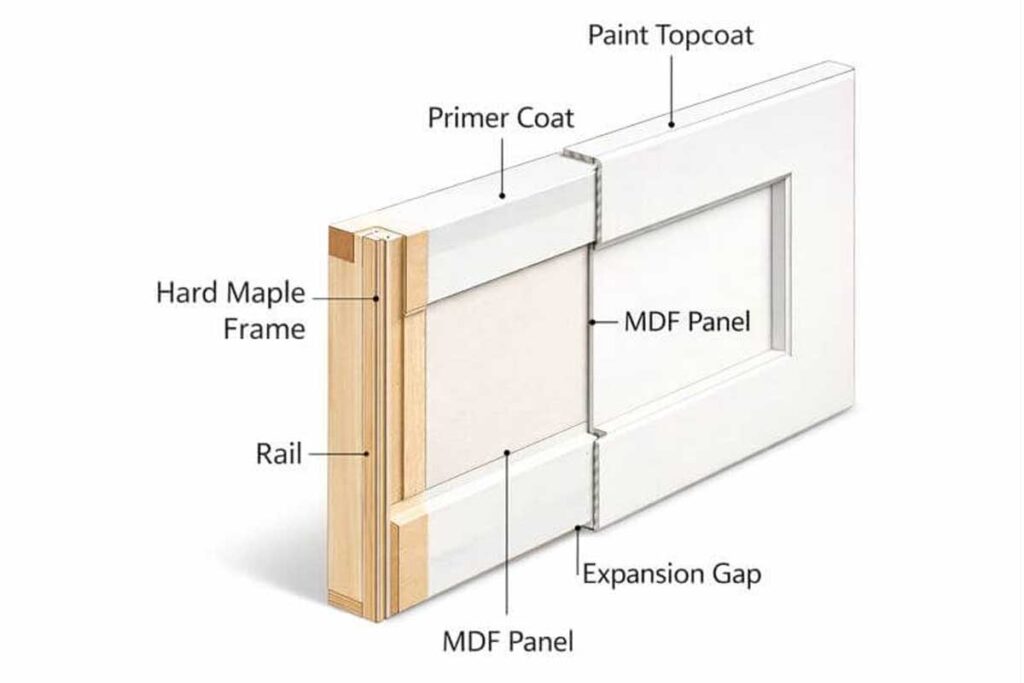
MDF belongs in painted doors as the center panel, because it stays flat and paints glass-smooth. Use solid wood for the frame (stiles/rails), and let the panel float with space for seasonal movement. (Yes—even MDF benefits from the right door construction.)
If you’re bonding or repairing MDF parts, use the right adhesive and prep—here’s what to know about how wood glue behaves on MDF: gluing MDF the right way.
What about poplar or alder for paint?
Poplar and alder can paint nicely, especially for face frames and trim, but they dent easier than the harder cabinet staples. They’re great when the budget is tight and you want a smooth paint job without fighting open pores.
What wood is better if you have kids, pets, or a high-traffic kitchen?
Hard maple, hickory, and oak are better for high-traffic kitchens because they combine higher dent resistance with strong long-grain structure.
Here’s the practical approach I use:
- Pick a harder species for doors and face frames (the parts you touch and bump).
- Use plywood for boxes and shelves (stability where it counts).
- Choose a forgiving sheen (satin or matte hides fingerprints and small scratches better than gloss).
- Seal the sink base like it owes you money (finish inside edges, toe-kick area, and any raw end grain).
And remember: the finish system often decides how “bulletproof” cabinets feel. A great shop-applied cabinet finish can make a mid-range wood outperform a premium wood with a thin, soft topcoat.
How do popular cabinet woods compare side by side?
A quick comparison helps you match the wood to the job instead of chasing a “perfect” species.
| Wood species | Grain look | Dent resistance (Janka, lbf) | Finish behavior | Where it shines |
|---|---|---|---|---|
| Hard maple (sugar maple) | Tight/subtle | ~1450 | Can blotch with dark stains | All-around, paint or light stains |
| White oak | Bold but clean | ~1360 | Stains predictably; open pores | Modern natural looks |
| Red oak | Bold/traditional | ~1290 | Takes stain well; open pores | Value stained cabinets |
| Yellow birch | Fine to moderate | ~1260 | Can stain splotchy if rushed | Budget-friendly hardwood look |
| Cherry | Smooth/fine | ~950 | Darkens with age/light | Warm traditional kitchens |
| Black walnut | Dramatic/rich | ~1010 | Often great with clear coat | High-end modern contrast |
| Hickory | Busy/varied | ~1500–1970 | Strong character, lots of variation | Rustic, high-wear kitchens |
| Pine (eastern white) | Soft/rustic | ~380 | Blotches without conditioning | Cottage style, low-cost |
Janka values and test description come from the Relative Hardness Table and its Janka test explanation.
What construction details matter more than the wood species?
Construction details matter more because they control movement, racking strength, and finish longevity.
- Door build: A proper frame-and-panel door prevents splitting because the panel floats.
- Joinery: Dados, rabbets, and strong fastener/adhesive choices keep boxes square.
- Hardware: Good hinges and slides prevent sagging and reduce stress on door joints.
- Finish coverage: Fully sealed edges and interiors reduce moisture cycling and cleanup damage.
If you want a reality check: a carefully built birch cabinet often outlasts a poorly built walnut cabinet.
How do you choose the best wood for your kitchen in 10 minutes?
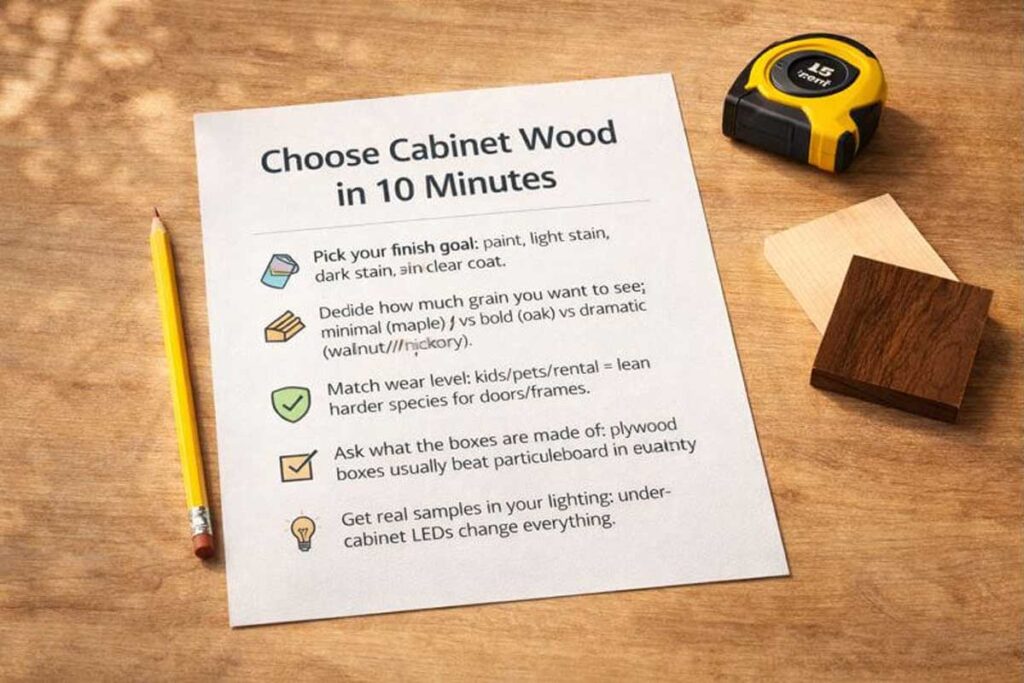
You choose faster when you decide on finish first, then durability, then budget.
- Pick your finish goal: paint, light stain, dark stain, or clear coat.
- Decide how much grain you want to see: minimal (maple) vs bold (oak) vs dramatic (walnut/hickory).
- Match wear level: kids/pets/rental = lean harder species for doors/frames.
- Ask what the boxes are made of: plywood boxes usually beat particleboard in long-term stability.
- Get real samples in your lighting: under-cabinet LEDs change everything.
Common Questions About Kitchen Cabinets Wood

Is birch a good wood for kitchen cabinets?
Birch is good when you want a hardwood look at a friendlier price, and you’re okay taking extra care with staining. Birch lands around 1,260 lbf on Janka (yellow birch), so it holds up reasonably well.
Do oak cabinets have to look dated?
Oak doesn’t look dated when the door style and finish fit the room. Flat-panel or slim shaker doors, lighter stains, and simple hardware can make oak feel clean and current. White oak is especially easy to push modern because its grain reads less “busy” than classic red oak.
Do cherry cabinets darken over time?
Cherry darkens over time because light and oxidation deepen the color, especially on sunlit runs. That change is normal and usually looks better after a couple years, but it can darken unevenly behind small appliances or décor. Today’s Homeowner calls out cherry’s ongoing color change as a real consideration.
Is MDF a bad choice for kitchen cabinets?
MDF isn’t automatically bad; it’s just application-specific. MDF works well for painted door panels and some interior parts, but it hates sustained water exposure. If you choose MDF anywhere near the sink, you need sealed edges and disciplined leak prevention.
How do I prevent blotchy stain on maple or pine?
Maple and pine blotch when absorbency varies across earlywood/latewood. Use a consistent sanding grit (don’t jump around), apply a conditioner or washcoat, and consider dye before pigment stain for more uniform color. For pine specifically, this guide helps: preventing pine blotching during staining.
What wood is best for a rental or Airbnb kitchen?
Hard maple or oak is a smart rental pick because it resists dents and cleans up well. Pair that with plywood boxes, soft-close hardware, and a durable cabinet finish, and you’ll reduce call-backs for loose hinges, sagging doors, and chipped corners.
Final thoughts on Kitchen Cabinets Wood
What wood is better for kitchen cabinets depends on what you need the cabinets to do: take hits, stay stable, and look right with your finish. If you want one safe answer that fits most homes, I’d start with hard maple for doors/frames and cabinet-grade plywood for boxes, then adjust toward oak, cherry, walnut, birch, or hickory based on the look you’re after.
Good luck, and don’t hesitate to demand real samples—wood always tells the truth in your own kitchen lighting.